


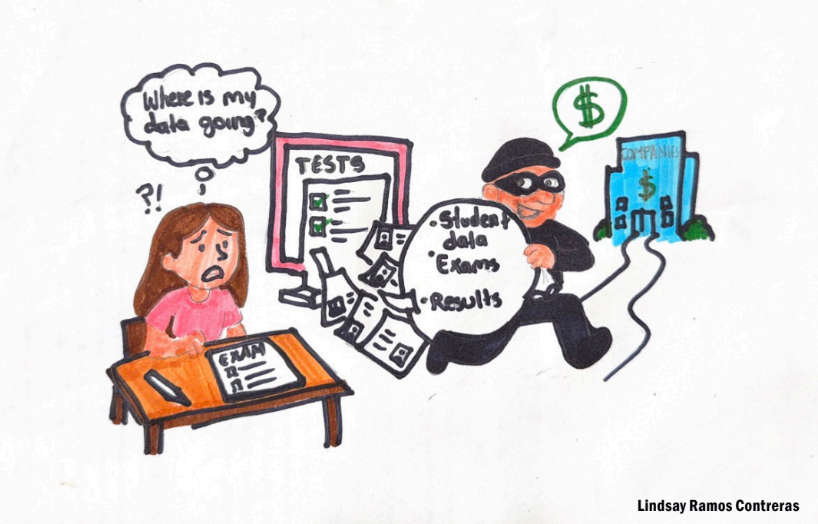
From a lawsuit alleging that i-Ready improperly shared student in- formation, to scam employment emails sent to OUSD students, to massive national data breaches, concerns about student digital privacy are becoming harder to ignore.
As students across the country have seen an increase in attempts to leak their personal data, we think companies should first and foremost ask for con-
sent before storing our information, and be held accountable when they are not transparent about how data is collected and used.
That’s what four California students and their parents alleged in a federal class-action lawsuit filed in December against Curriculum Associates, the company that owns i-Ready.
The families claim that i-Ready has been sharing student information like their name and contact information, identifying demographic information, assignment submissions, assessment scores, behavioral and interaction data and IP addresses.
Curriculum Associates asked the court to dismiss the lawsuit onFeb. 27, and on Apr. 3 the families filed their opposition to the motion. The company argues there is insufficient evidence to support the claims by the parents and students.
Leaks of information aren’t foreign to Oakland Unified School District, or school districts nationwide. In fact, there was a recent leak that caused many OUSD students to get an email regarding “job opportunities.”
Some students reportedly opened the email and input their information to get a paying job. Some of those students may not have realized that entering personal information into the form could put their data or finances at risk.
This recent scam was addressed in an email by OUSD’s Director of Communications, John Sasaki, to students, which was rebutted by a Skyline parent for putting the responsibility of not being scammed onto the student.
The parent, Edmund Chun, wrote in an email to Sasaki: “It appears that Skyline parents have greater concern over student privacy than the district.”
Nina Glasgow-Shiroma, a 10th grader at Skyline, raised the question of why scammers would target students instead of adults, who she noted have more of a financial background.
Some students believe scammers target teenagers because they may be less expe rienced identifying scams.
“When I read through it (the form linked in the spam email), I knew it was a scam, but I did click on the link,” Glasgow-Shiroma said.
Additionally, Canvas — the app college students use including some of Skyline’s dual enrollment classes — was shut down on May 7, for security purposes. The website was allegedly hacked by a group called ShinyHunters, who claims they have breached over 275 million indi- viduals’ data and had access to billions of private messages.
These incidents suggest that students may be particularly vulnerable to scams and data breaches because they may be more likely to open spam emails or agree to terms without fully understanding them.
Lon’ja Mustafa, a senior who has used Canvas in a dual enrollment law class, said she was disturbed by reports about the data breach. Those reports alleged that ShinyHunters threatened to release student data and messages if Canvas did not pay a ransom.
“It feels like an invasion, like they are taking something that belongs to us,” Mustafa said.
Following these events, OUSD should clearly explain what student information educational platforms collect, how long it’s stored, and whether students and families can opt out. Students should not be expected to hand over personal data without understanding where it goes.
Furthermore, when the district become aware of a breach, OUSD should let parents know, as well as students. Our student data should not be for sale.