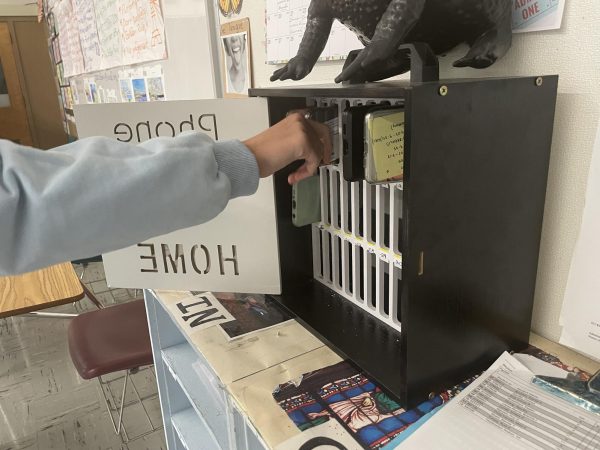

What’s the item most reached for at school? No doubt, it’s your cell phone.
This has been a growing conflict for students and teachers statewide. So much so that Gov. Gavin Newsom signed the Phone-Free School Act last September to intervene in the conflict and to force all public schools in California to implement a phone-free environment. The law, which takes effect July 1, is designed to help students academically. It also is supposed to reduce cyberbullying, and improve young people’s mental health and social interactions.
Principal Rebecca Huang said Oakland Unified School District has not yet informed her about specific changes it will require.
While the specifics of the policy are unknown, many students say they’re concerned about safety. In a survey of 104 students conducted by The Oracle, many said phones are needed for communication in emergencies.
“When it comes to a dangerous situation, students must be able to contact parents or guardians immediately,” wrote AED senior Samantha Granados. Another student wrote about how her phone had helped her during a school lockdown.
“I was able to text my friends and make sure they were okay, and I was able to text my family, and tell them that I was safe and that I loved them,” wrote AED senior Bridget Epstein.
Forty-eight percent agreed that the law could “improve student learning and well-being by reducing distractions and promoting in-person social interaction.”
However, 61 percent said cell phones did not hurt their learning, and 77 percent said the law was unnecessary.
Principal Huang explained that the phone boxes now in classrooms are not under district jurisdiction and that teachers, for now, decide how to enforce the no-phone policy listed in the student handbook.
She said the phone boxes “can be a very good thing” because it is hard for students to practice self-discipline when their phones are near.
“It can allow focus,” she said. Teacher Shannon Silberhorn started using a phone box two years ago. She said she finds herself teaching more and spending less time redirecting students.
“Not having a phone on you is important because it makes sure you’re able to engage with everyone at your table,” she said, adding that students reacted negatively the first year.
Oakland High School started its phone-free classroom policy campus-wide this year.
Kiana Fong, a reporter for the O-High newspaper, told The Oracle, “Some students complain, saying, ‘I hate how we can’t use our phones.’”